Off-market platform: what makes a good one and what only looks like one
Almost every portal now calls itself off-market. The term is not protected, and it shows. Four tests separate a platform on which deals are made discreetly from a listings portal under another name.
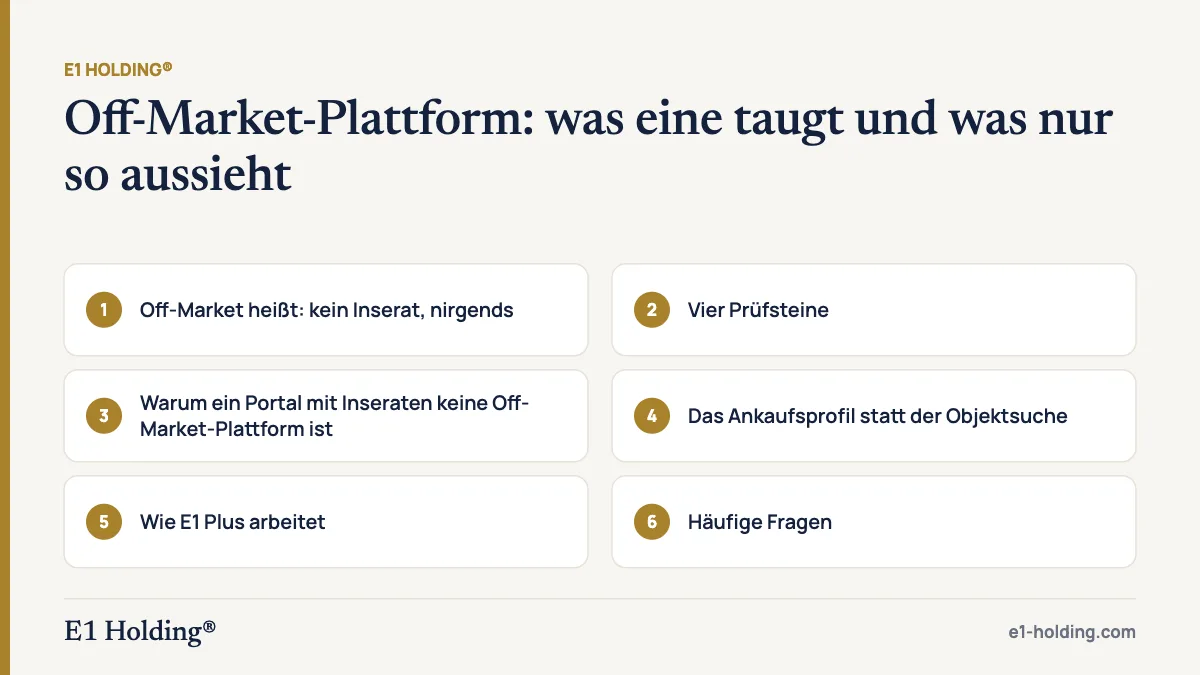
Off-market means: no listing, anywhere
A property is off-market if it is not offered publicly — not on a portal, not in an advertisement, and not on a website with a photo gallery. The seller usually has a specific reason for this: tenants should not find out, competitors should not see that a sale is taking place, or a community of heirs does not want a public discussion about the family’s assets.
This leads to the first test: If you can see property data without identifying yourself, it is not off-market. A platform that shows exposés openly and only withholds the address is running a listings portal with a blur.
Four tests
| Test | The question you ask | What a bad answer is |
|---|---|---|
| Origin | Where do the properties come from? | “From our network.” A reliable system says whether the provider is the owner, an agent or a manager, and since when the transaction has been running. |
| Counterparty | Who is vetted before seeing anything? | No vetting. If every registration gets immediate access, your property data is available to anyone who can fill in a form. |
| Confidentiality | What has been signed before documents are shared? | A tick box for the T&Cs. A confidentiality agreement worthy of the name specifies the transaction, the duration and the consequence of a breach. |
| Afterwards | What happens after my enquiry? | An automatic confirmation and then nothing. Ask who takes the next step and how you can see that it has been taken. |
The quietest test is the most important. Ask what happens to your data if no deal comes about. Anyone who has no clear answer to that has no clear deletion routine either — and your acquisition profile will still be on a mailing list three years from now.
Why a listings portal is not an off-market platform
A listings portal is built to generate reach. The more people see a property, the better it works. An off-market platform is built for the opposite: the fewer people see a property, and the more precisely those few fit, the better it works.
Both models are legitimate. They simply cannot be mapped in the same software, because they pursue opposing goals. That is why the question about the origin of the properties is so revealing: a portal that gathers properties from public sources and labels them “off-market” has simply swapped the labels.
The acquisition profile instead of the property search
The useful reversal looks like this: instead of searching through properties, you register what you are looking for — location, property type, size, multiplier, equity, time frame. The system matches new transactions against it and notifies you when something fits. You then do not see everything, but the few things that belong to you.
For providers, the same works in the other direction: you find out how many registered profiles match a property before deciding whether to market it at all.
How E1 Plus works
E1 has been brokering off-market since 2007 and manages transactions on its own platform. Brokerage starts at two million euros, and acquisitions for its own account from five million. Property documents are only shared after a signed confidentiality agreement, and the point at which the commission split is fixed for all parties is the expression of interest — not the viewing and not the notary appointment.
There is a sober reason why this point is brought forward: under § 654 BGB (German Civil Code), an agent can forfeit their fee if they breach their duty of loyalty. Anyone who only discusses the split after the viewing is negotiating at a time when interests are already diverging.
Two ways in
Frequently asked questions
Is off-market more expensive than the open market?
Not fundamentally. Off-market saves marketing costs and time, but lacks the price pressure of a bidding process. Which route achieves more depends on the property and the number of suitable buyers — not on the procedure itself.
When is off-market ruled out?
When the seller has to prove that they achieved the highest price. This applies to public and municipal owners, boards of public limited companies and insolvency administrators. In these cases, the open procedure is the right route.
Do I have to reveal my identity as a buyer?
To the platform, yes, otherwise it cannot be checked whether you are able to acquire the property at all. To the owner, not initially — your identity is only disclosed when you want it to be.
What distinguishes a platform from an agent?
The platform holds the inventory and the matching; the agent manages the transaction. Both are needed. A platform without people behind it reports matches that nobody checks.
How much time does finding the right buyer cost you today?
An E1 Plus account without a licence is permanently without fees.
Start on E1 Plus now →Ohne Gebühren für Sie: Jetzt Gastbeitrag veröffentlichen →Passend dazu: Strategiegespräch inkl. digitalem Ankaufsprofil – 199 € → Alle E1-LeistungenOder direkt per E-Mail: info@e1-holding.comYour question on this topic
Name, email and message are enough. We assign your enquiry to this page and reply personally.
Contracts & forms
Part A: e1-holding.com / E1 Plus platform · Part B: brokerage services
Fill in & sign online →PDF (fillable) ↓Application for inclusion of a company in the company directory on e1-holding.com
Fill in & sign online →PDF (fillable) ↓Initial registration in the E1 network with choice of role and reference to the appropriate follow-up documents
Fill in & sign online →PDF (fillable) ↓Off-market properties on this topic
Snapshot – availability and details on request. · View all off-market properties →
Current acquisition requests from investors
More images on this topic